
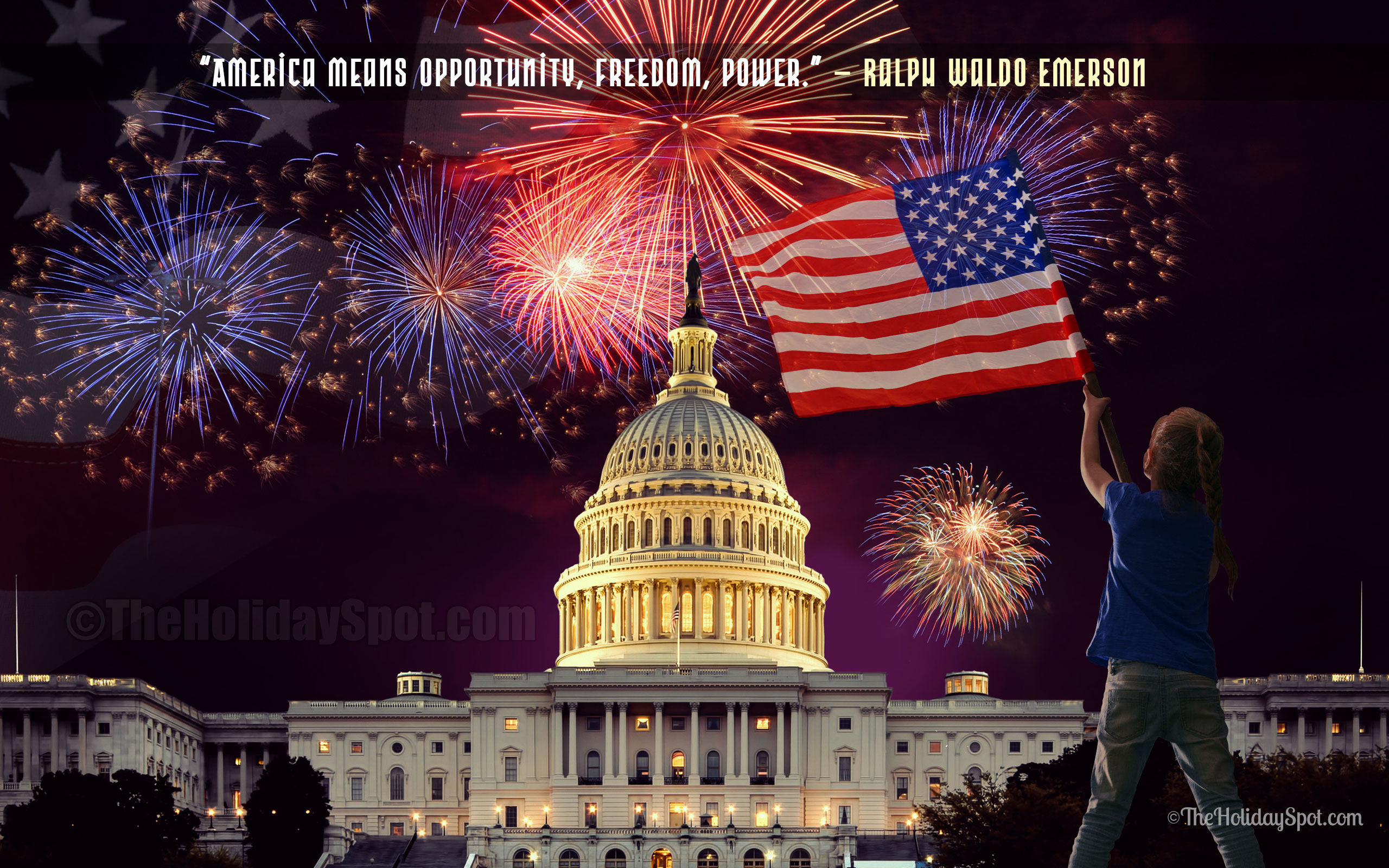
The 4th of July is widely known as the Independence Day of the United States. It is believed to be identified with “freedom,” functions as a symbol of a long-lived value in the American society that fellow Americans as well as foreigners can associate with (‘freedom’).
‘Freedom’ itself is fluid.
Many people and scholars from different backgrounds try to explain in the way
people can understand, but none has never been fixed to set what it really is. It is universal, yet culturally relative. It is demanded, but hard to articulate. It is felt, but feelings are..personal. Yet, the American society agrees on what kind of ‘freedom’ this
Independence Day signifies; that it must embrace the truest form of all, that freedom
is absolute.
‘Freedom’ in American
society is built on the basis of commonality that bounds the structure of
feeling of Americans, creating the so-called “American culture.” And in
American culture context, commonality can be explained in two main
streams.
Commonality in American Culture
The first stream consists of
scholars and scientists who try to accommodate the answer of how to define
‘commonality’ in American culture which departs from a question whether there
is a common American culture. Among them is Robert N. Bellah who explains that there
is a commonality shared by Americans as a result of what ‘(American) stakeholders’
create and preserve.
The commonality comes from a ‘powerful institutional order’ carrying a ‘powerful common culture’ to forge the ‘commonality’ in the society understood as a product of American culture. According to Bellah, the ‘mission’ (of forging a commonality) is being carried out by agents of socialization which here are states and market. Two purveyors responsible in doing so are educational system/institution and television (as a representation of mainstream media). These two purveyors created a common culture that people identify as “American culture.” One of the products is the ‘American English’ (as the nationwide spoken language).
‘American English’ is a
sample of commonality that American society shares. It is used as a language
that all Americans must understand and use (alongside the multi-languages
one American could have) regardless of their origins such as Brazil, Indonesia, Afghanistan, Ghana, India, or anywhere else outside of the territory of the United States. Americans
are forged to speak ‘American English’ once the identity of an ‘American’ is
attached to them.
The language—the ‘American
English’—is one among many cultural products that can help identify a play of ‘dominant
element’ forging the common culture which Robert N. Bellah refers as “utilitarian
individualism.” In “utilitarian individualism,” the dominant element is the attitude of ‘expressive individualism’ (open, straightforward, expressive individuals) which has roots in Anglo-American
Romanticism as well as diverse influences from Europe ethnic, African American,
Hispanic, and Asian influences. But even though the common culture shared by
Americans is rooted in and influenced by a lot of different causes, the value
of ‘freedom’ from American Puritan ancestors sets what ‘freedom’ is commonly
understood throughout the nation; and this value of ‘freedom’ gives
grounds to other forms of “freedom” in the America. It is felt, expected, and translated in many forms and perspectives.
Commonality and American Culture
The second stream is the stream consists of scholars and scientists who offers critics. Jeffrey Goldfard, as a part of the group, suggests an alternative way of understanding the ‘commonality’ in the American culture. He rather questions whether the society in the United States (today, still) perform commonality as has been long-believed than to offer the idea of what ‘commonality’ is among them. In his essay, Goldfard believes that the so-called “American culture” has come to a decline and fall due to several causes.
As he points out, in the general frame, the decline and fall of commonality in the “American culture” happen due to the erosion of ‘democracy’ and ‘cultural excellence’ with the ascendancy of mass society and its culture Goldfard questions the the notion of ‘true democracy,’ as democracy itself is claimed and associated with “(the United States of) America” in order to point out 'commonality' (in the American culture which includes the notion of ‘freedom’) shared in the American culture should have never been a game played by elites to control over the society (by forging the culture).
The critics depart from seeing how education, politics, and public figures can actually influence the society’s behavior by outlining how the powerful institutions are that powerful to forge culture and commonality unless people begin to challenge the circumstances around them. Let the culture grows and shapes its own characteristics. Let the powerful institutions responsible in keeping the nation strongly united, but not in the way how the culture of the society must be—because this seems to contradict with the ‘freedom’ that the 4th of July signifies. Otherwise, the 'freedom' rooted in individualism as claimed and campaigned by "Americans" will get blurred by the interference of stakeholders.
Conclusion
Seeing how the United States celebrates their 4th of July in 2020 (which we know 2020 is quite something to the world, especially in this case the United States), I would say that right now is among times when society must restructure their own society, culturally. ‘Freedom,’ which is believed to be one of the things that forge ‘commonality’ in the American culture needs to rewrite its significance. Until ‘freedom’ is commonly set and achieved, what 4th of July signifies is not (at least, yet) the commonality in the American culture as culture itself grows, changes, and develops.
-Alifa Salsabila
Comments
Post a Comment